
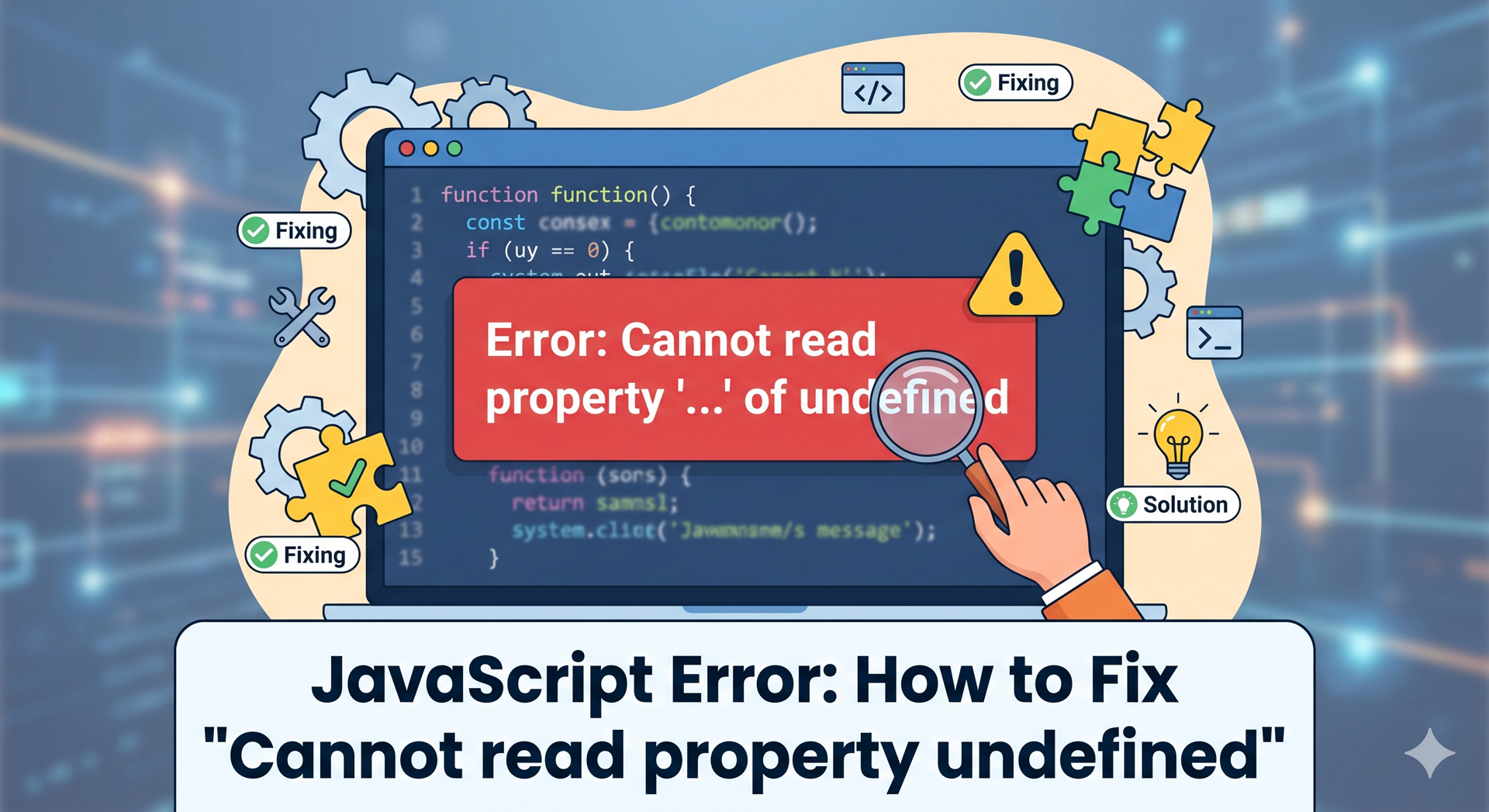
Ever stared at your JavaScript console, only to be greeted by the dreaded “Uncaught TypeError: Cannot read property ‘…’ of undefined”? It’s a moment of dread for many developers, a cryptic message that can halt your progress and send you down a rabbit hole of confusion. This error, often abbreviated as “Cannot read property undefined,” is one of the most common stumbling blocks in JavaScript development. But don’t despair! It’s not some insurmountable mystery; it’s a clear signal that something isn’t quite where you expect it to be.
Think of it like trying to grab a tool from a toolbox that’s either empty or the tool you’re looking for isn’t there. Your code is asking to access a specific property (like name or length) on something, but that “something” is currently undefined. It’s like trying to read the title of a book that hasn’t been written yet, or asking for the price of an item that isn’t in stock. Understanding why it’s undefined is the first and most crucial step to resolving this common headache.
This article is designed to demystify this error. We’ll break down what it actually means, explore the common scenarios where it pops up, and most importantly, equip you with the practical strategies and techniques to effectively debug and fix the “Cannot read property undefined” error, allowing you to get back to building awesome things with confidence.
Understanding the Undefined Error
At its core, the “Cannot read property ‘…’ of undefined” error signifies a fundamental mismatch: your code is attempting to access a property or method on a value that doesn’t exist. In JavaScript, undefined is a primitive value that represents the absence of a value. It’s not null (which explicitly means “no value”), nor is it zero or an empty string. It simply means that a variable, object property, or array element hasn’t been assigned any value yet, or it’s been explicitly set to undefined.
Imagine you’re trying to get the color from a car object. If you haven’t defined the car object yet, or if it exists but doesn’t have a color property, your code asking for car.color will hit a wall. JavaScript doesn’t know what color is because car itself is either non-existent (undefined) or incomplete. This is why the error message is so specific: it’s telling you precisely what’s missing – the property you’re trying to read, and the fact that the thing you’re reading from is undefined.
This error is incredibly prevalent because JavaScript is a dynamically typed language, and it’s very easy to accidentally create situations where a value is not what you expect. From typos in variable names to asynchronous operations that haven’t completed, there are many paths that can lead to this seemingly innocent undefined value, and subsequently, this frustrating error.
Debugging Your Undefined Property
Once you’ve grasped what the error means, the next logical step is to hunt down the culprit. Debugging the “Cannot read property undefined” error often involves a bit of detective work, tracing the flow of your code to pinpoint where the undefined value originates. The most straightforward approach is to use your browser’s developer console. When the error occurs, the console will usually provide a stack trace, showing you the exact line of code where the error happened.
Start by examining that specific line. Who is the variable or object you’re trying to access a property from? Is it a variable you declared? Is it a property of another object? Think about the context. Was this variable supposed to be initialized earlier? Did a function that should have returned a value actually return undefined? Sometimes, simply logging the problematic variable or object to the console just before the error line can reveal its undefined state, giving you a clear clue.
Beyond simple logging, understanding common pitfalls is key. Are you dealing with asynchronous operations like fetch requests or setTimeout? If so, the data you expect might not be available yet when your code tries to access it. Ensure your asynchronous code is properly structured with async/await or .then() to guarantee that the data is ready before you try to use it. Also, be mindful of typos in property names or variable names – a simple spelling mistake can easily lead to undefined.
Debugging Your Undefined Property (Continued)
Another powerful debugging technique is to use conditional checks. Before you attempt to access a property, you can check if the object or variable actually exists and has the expected property. This can be done with simple if statements, the logical AND operator (&&), or the optional chaining operator (?.). For instance, instead of user.address.street, you could write user && user.address && user.address.street or, more concisely, user?.address?.street. This prevents the error by short-circuiting the access if any part of the chain is null or undefined.
Consider how you’re iterating over arrays or objects. If you’re using a for...of loop or forEach on an array that might be empty or contain undefined elements, your logic within the loop might be attempting to access properties on those undefined items. Again, adding checks inside your loop can save you from this error. Similarly, when working with external data like JSON from an API, always assume that certain properties might be missing and implement defensive coding practices.
Finally, break down complex operations. If you have a long chain of property accesses or a series of function calls that lead to the error, try to isolate each step. Log the intermediate results of each operation. This methodical approach helps you narrow down the exact point where the undefined value is introduced, making it much easier to fix the underlying problem.
The “Cannot read property ‘…’ of undefined” error, while initially intimidating, is ultimately a signpost pointing you towards a logical flaw in your code. It’s your program’s way of saying, “Hey, I can’t do what you’re asking because the ingredient I need is missing!” By understanding that undefined means a lack of value and by employing systematic debugging techniques, you can transform this common frustration into a learning opportunity.
Remember, the goal isn’t just to fix the immediate error, but to understand why it happened. Was it a missed initialization? A typo? An asynchronous operation that wasn’t ready? Each time you encounter this error and resolve it, you’re building a stronger mental model of how JavaScript works and how to write more robust code. Embrace these challenges as part of the development process, and you’ll find yourself becoming a more confident and capable JavaScript developer.
So, the next time you see that dreaded “Cannot read property undefined” message, don’t panic. Take a deep breath, fire up your developer console, and start tracing. With a bit of patience and the right approach, you’ll be cracking this common error like a pro in no time, and your code will thank you for it.