
A slow website doesn’t just frustrate visitors — it quietly damages your business. People leave, search rankings drop, and conversions disappear before you even realize there’s a problem. In many cases, the issue isn’t the website design or the content. It’s the hosting setup behind it.
Businesses often spend heavily on branding, SEO, and ads, but ignore the foundation that keeps the site running fast and stable. The result? Downtime, sluggish loading speeds, and unhappy users.
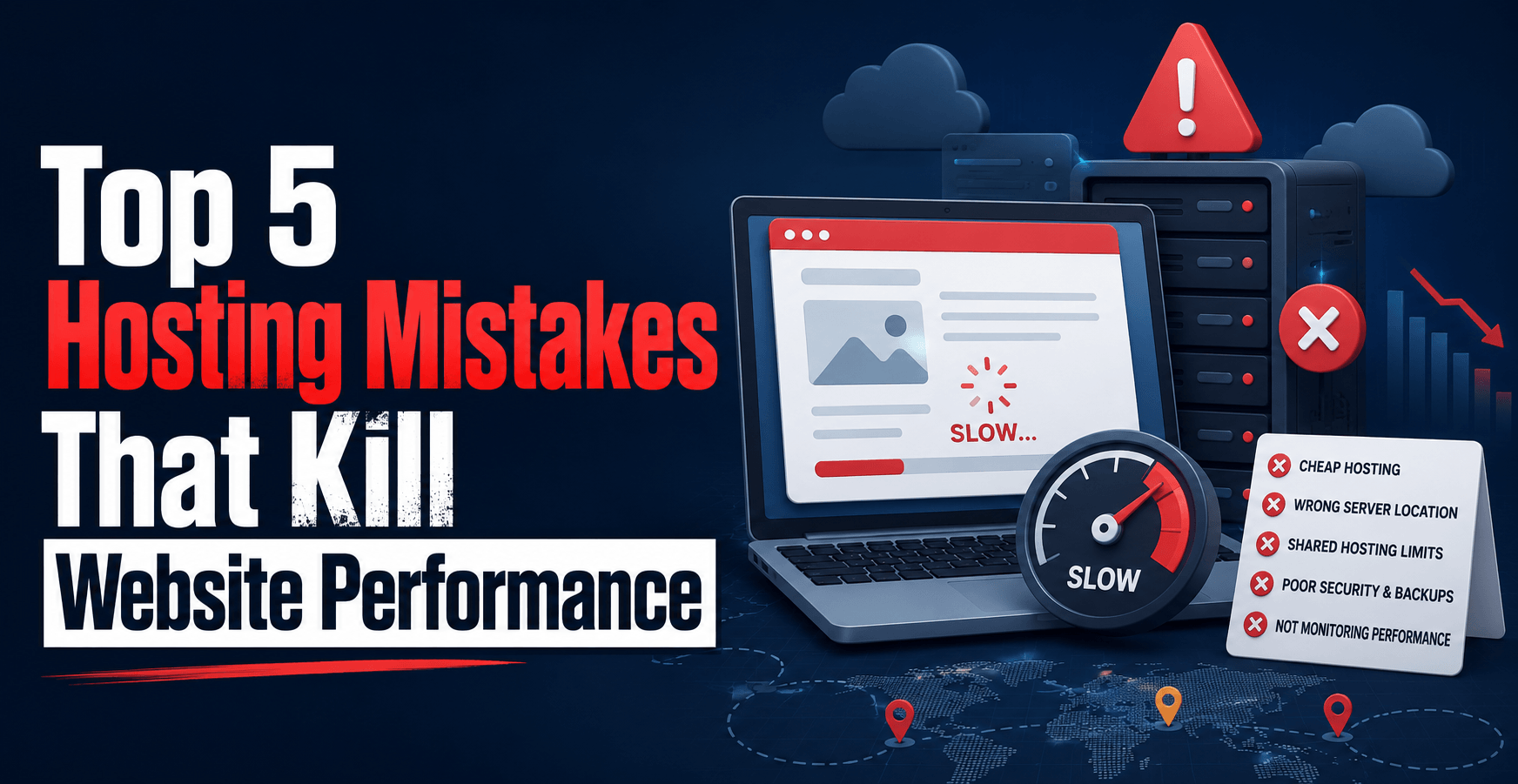
Here are five common hosting mistakes that seriously hurt website performance — and what you should do instead.
1. Choosing Hosting Based Only on Price
Cheap hosting looks attractive in the beginning, especially for startups and small businesses. But extremely low-cost hosting plans usually come with major compromises.
Most budget providers overload a single server with hundreds or even thousands of websites. That means your site is constantly competing for resources like CPU, RAM, and bandwidth. When traffic increases, performance drops instantly.
You may notice:
- Slow loading times during peak hours
- Frequent downtime
- Delayed customer support
- Security vulnerabilities
- Poor SEO performance
Saving a few hundred rupees per month can end up costing far more in lost visitors and sales.
Better Approach
Choose hosting based on reliability, uptime, support quality, and performance — not just price. A slightly higher investment in quality hosting often delivers significantly better results.
2. Ignoring Server Location
Many website owners never think about where their server is physically located. But distance matters.
If your audience is in India and your server is in another continent, data takes longer to travel. That delay increases page loading time, especially on mobile devices.
Even a one-second delay can affect:
- User experience
- Bounce rate
- Conversion rates
- Search engine rankings
Better Approach
Pick a hosting provider with servers close to your target audience. If your visitors are mostly from India, choose Indian or nearby Asian data centers. You can also use a CDN (Content Delivery Network) to improve speed globally.
3. Using Shared Hosting for High-Traffic Websites
Shared hosting works well for new or low-traffic websites. But as your traffic grows, shared hosting becomes a limitation.
Since resources are shared among multiple websites, one sudden traffic spike from another site can slow yours down immediately. This issue is known as the “bad neighbor effect.”
Common signs include:
- Website freezing during traffic spikes
- Slow admin dashboard
- Timeouts and server errors
- Poor checkout performance for eCommerce stores
Better Approach
Upgrade when your traffic starts growing. VPS hosting, cloud hosting, or dedicated servers offer better stability and performance. The right hosting plan should scale with your business.
4. Neglecting Security and Backups
Website performance isn’t only about speed. Security also plays a huge role.
A hacked or infected website often becomes extremely slow. Malware can consume server resources, damage SEO rankings, and even get your site blacklisted by search engines.
Many businesses realize the importance of backups only after losing important data.
Better Approach
Always choose hosting that includes:
- Automatic backups
- Malware scanning
- SSL certificates
- Firewall protection
- DDoS protection
Regular backups and proper security measures protect both performance and business continuity.
5. Not Monitoring Website Performance
Many website owners assume everything is fine as long as the homepage opens. But performance issues often build slowly over time.
Without monitoring tools, you may never notice:
- Increasing server response times
- Downtime incidents
- Plugin-related slowdowns
- Database overload
- Resource usage spikes
By the time customers complain, the damage is already happening.
Better Approach
Use tools like Google PageSpeed Insights, GTmetrix, or uptime monitoring services to track performance regularly. Monitoring helps identify issues before they affect users.
Final Thoughts
Your hosting provider is the foundation of your website. Even the best-designed site will struggle if the hosting environment is slow, unstable, or poorly managed.
Avoiding these five mistakes can dramatically improve:
- Website speed
- User experience
- SEO rankings
- Conversion rates
- Overall business credibility
A fast and reliable website creates trust. And in today’s digital world, trust directly impacts growth.
Invest in hosting the same way you invest in design, marketing, and content — because performance is not optional anymore.